
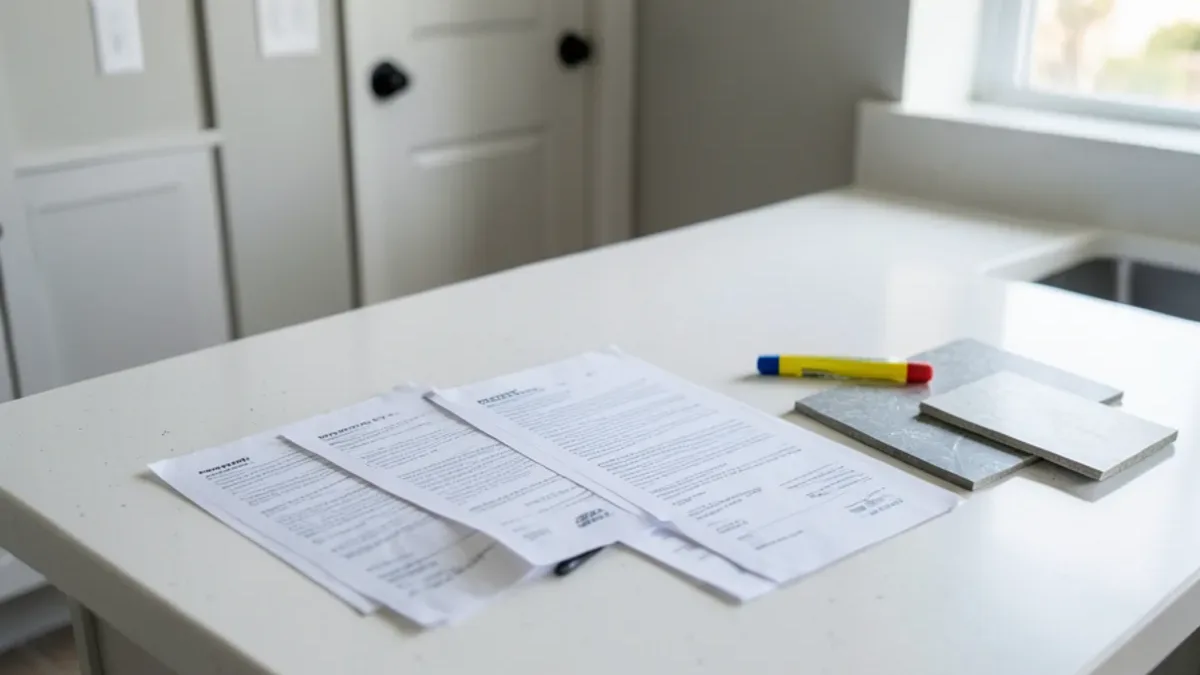
How do you compare kitchen remodel bids on equal terms?
Most bid confusion comes from bidders pricing different projects. One assumes the sink stays put, another moves it; one includes the backsplash, another leaves it as an allowance. Fix that before comparing totals by giving every bidder the same written scope: layout, cabinet line and door, countertop material and edge, backsplash area, flooring, appliances you are supplying, and what happens to the old kitchen.
Choosing finishes before you request bids makes this far easier. If your cabinets, counters, tile and floor are already selected, the bids only differ on labor, trades, permits and management, which is what you actually want to compare. The kitchen design page explains how a layout gets pinned down.
Want to see the options in person?
The Sherman Way showroom has cabinets, counters, tile and flooring on display side by side. Call before you come and say what you're working on.
- Showroom at 13259 Sherman Way, North Hollywood
- 20 Google reviews
- BBB rating A+
- Cabinets, counters, tile & floors in one place
What should every written bid include?
- Contractor name, address, CSLB license number and classification
- A scope description detailed enough that a stranger could build from it
- Cabinets, countertops, backsplash, flooring and fixtures named with line, material, finish and quantity
- Demolition, haul-away and disposal as their own line
- Plumbing, electrical, gas and ventilation work described, with who performs it
- Permit fees and who obtains the permit
- Allowances in dollars, with what each covers
- Exclusions in plain words
- A start window, expected duration and how delays are handled
- A payment schedule tied to completed work, and how change orders are priced

Allowances and exclusions: where bids quietly differ
| Bid term | What it means | Question to ask |
|---|---|---|
| Allowance | A placeholder amount for an item not yet chosen | Is this enough for the material I actually picked? |
| Contingency | Money held for hidden conditions | Who decides when it is used, and do I get unused funds back? |
| Exclusion | Work the bid does not cover | Who does this work, and what will it cost? |
| By owner | Items you supply, such as appliances | When must they arrive, and who installs them? |
| Change order | A written price for added or changed work | What markup applies to changes? |
Watch for allowances that are unrealistically low for the finish level you described, and for exclusions that cover the parts most likely to come up in an older house, such as subfloor repair or electrical panel upgrades.
How do you check a contractor’s license in California?
Use the license lookup on the Contractors State License Board website, cslb.ca.gov. It takes a few minutes and should happen before you compare prices.
- Enter the license number from the bid, not just the business name.
- Confirm the license is active and the name matches the company on the contract.
- Check the classification. A B (general building) license covers multi-trade projects; specialty licenses include C-6 cabinet and millwork, C-15 flooring, C-54 tile, C-36 plumbing and C-10 electrical.
- Look for the contractor bond on file; CSLB requires a $25,000 bond for active licenses.
- See whether workers’ compensation coverage is listed or the contractor has an exemption, and ask why if it is exempt but uses a crew.
- Review any public complaints or disciplinary actions shown.
California requires a license for jobs of $1,000 or more in combined labor and materials, and for any work that needs a permit. If a bidder cannot give you a number that checks out, the comparison is over.
What should you ask during each bid walk-through?
The paper bid tells you the price. The walk-through, when the bidder stands in your kitchen, tells you how the job will actually be run. Ask every bidder the same questions and write the answers on their bid so the comparison stays honest:
Who runs the site day to day?
Get a name for the person who will be there or answer the phone, and how often they will check the work.
Which trades are subcontracted?
Plumbing, electrical and countertop fabrication are often subcontracted. Ask for each subcontractor’s license number too, and check it the same way.
What happens when demolition finds a problem?
The answer you want is a written change order with a price, signed before the extra work starts.
Who orders and receives the materials?
Someone has to check cartons against the order on delivery day. If it is you, plan for it.
How is the rest of the house protected?
Dust walls, floor protection along the route and daily cleanup should be described, not assumed.
Lien releases: the paperwork homeowners forget
In California, subcontractors and material suppliers who are not paid can record a mechanics lien against your property even if you paid the main contractor in full, as CSLB explains in its consumer guidance. A supplier may send a preliminary notice early in the job; it is not a lien, but it tells you who has a stake. Ask for lien releases from the contractor, and from major subcontractors and suppliers, as payments are made.
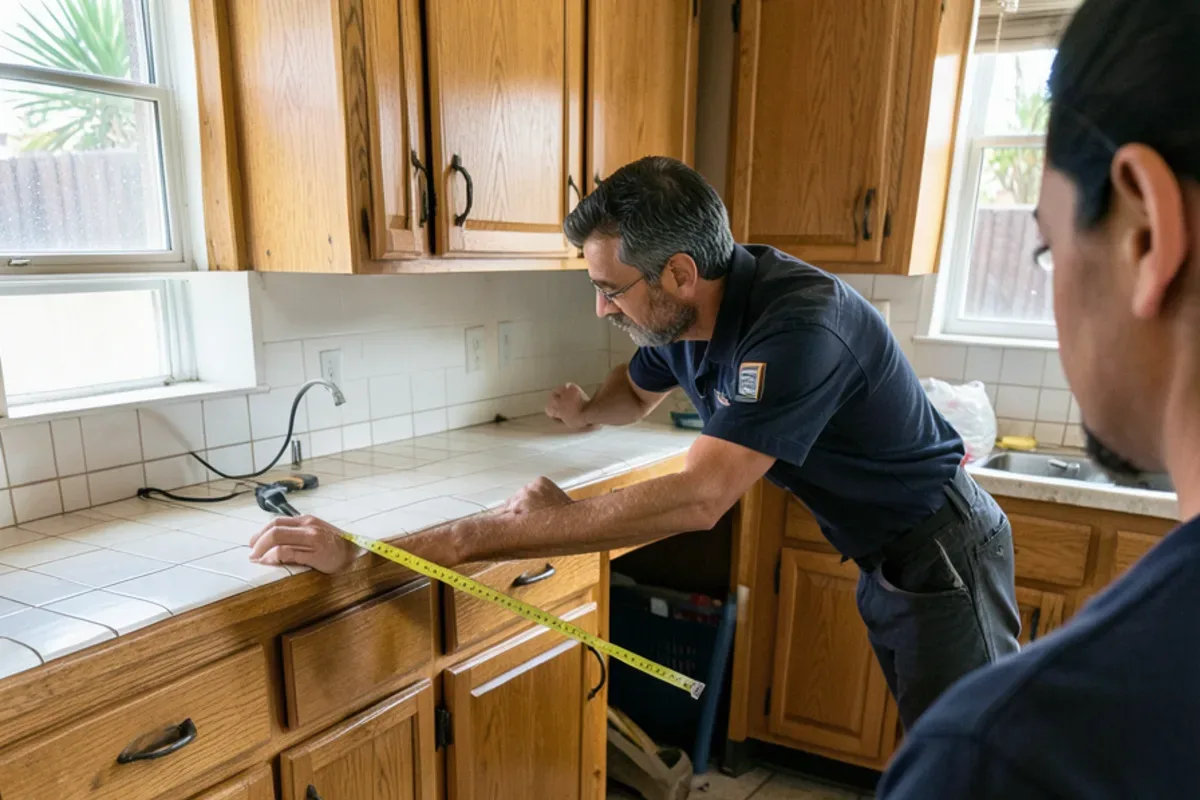
Payment schedules and the red flags behind them
California law, as CSLB explains, limits the down payment on most home improvement contracts to 10 percent of the contract price or $1,000, whichever is less. After that, payments should follow work that has actually been done. Be cautious about any bid that:
- Asks for a large cash payment up front, or payment for materials before a delivery date is set
- Suggests skipping the permit to save money or time
- Has no written scope, only a total
- Pressures you to sign the same day
- Lists a license number that does not match the company name
California also gives homeowners a right to cancel many home improvement contracts within a few days of signing, with a longer window for seniors. The contract should explain it; CSLB’s consumer pages describe the details.
Reading the material lines with a showroom eye
The material lines are where two bids that look alike often are not. When homeowners bring competing quotes to the Sherman Way showroom, these are the details worth checking side by side:
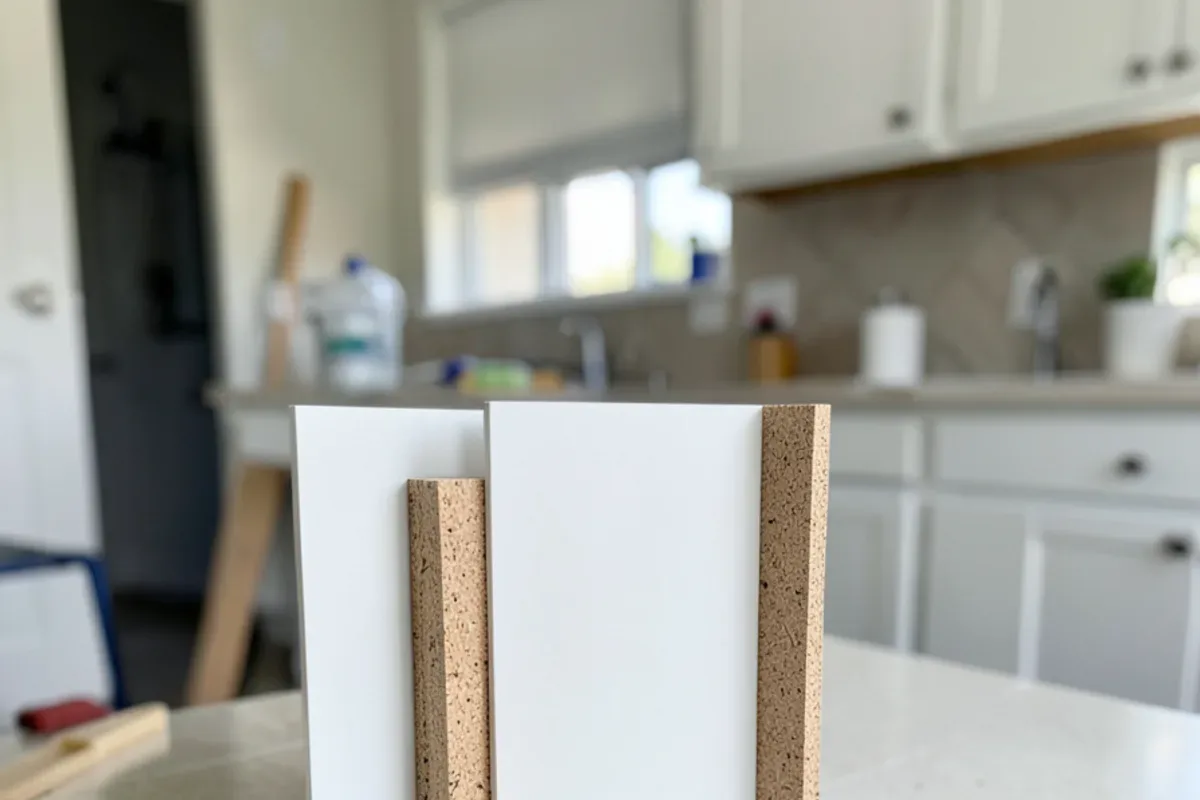
- Cabinet box construction: plywood, MDF or particleboard, and drawer glide type.
- Countertop: slab or prefabricated, thickness, edge profile, number of cutouts and whether the sink is undermount.
- Tile: square footage including overage, pattern, and whether trim pieces are counted.
- Flooring: product type, underlayment, and whether old flooring removal and leveling are included.
- Hardware and fillers: pulls, crown, light rail and end panels add up on a long run.
Google reviewers describe the showroom team matching or beating other quotes within reason, so a detailed competing bid is a useful thing to bring along.
Turnkey bid or materials bought separately?
Some homeowners choose cabinets, counters, tile and flooring at a showroom and hire a builder only for demolition, trades and permits; others want one bid that covers everything. Neither is automatically cheaper. A turnkey bid puts one party in charge of every delivery and every mismatch, usually with a markup on materials. Buying materials directly can save that markup, but you then own the coordination: dimensions must match the builder’s plan, arrival dates must suit the schedule, and someone has to confirm who fixes a damaged door. If you go that route, make sure the builder’s bid lists the materials as owner-supplied and states who handles cabinet installation, countertop templating and tile setting.
Building a bid package that is easy to compare
The cleanest comparisons come from a fixed set of materials and a written layout. Start on the kitchen remodeling in Los Angeles page to see how cabinets, counters, tile and floors are chosen together, then firm up the plan on the kitchen design page. Homeowners in Los Angeles use LADBS for permits, while Beverly Hills runs its own building department, so make sure each bid names the right office.
Quick answers
How many bids should a homeowner collect for a kitchen?
Three written bids on the same scope is the usual target. Fewer makes it hard to tell what a fair price is; many more takes time without adding much. Send each bidder the same layout and material list, and ask them to separate cabinets, counters, tile, flooring, trades, permits and disposal so the totals can be compared line by line.
Why is one kitchen bid much lower than the rest?
Usually because it covers less. Check for missing permit fees, low allowances, excluded demolition or disposal, or a different cabinet construction. Sometimes the bidder plans to skip the permit altogether. Ask the low bidder to price exactly the same scope as the others; if the gap disappears, so does the bargain.
What license classification should a kitchen contractor hold?
For a remodel involving several trades, a B general building license is typical. Specialty work can be done under classifications such as C-6 cabinet and millwork, C-15 flooring, C-54 tile, C-36 plumbing and C-10 electrical. Confirm the classification on the CSLB lookup matches the work in the bid, and that the license is active.
Do Beverly Hills kitchen projects go through LADBS?
No. Beverly Hills is a separate city with its own building and safety department, so permits, fees and inspections follow City of Beverly Hills rules rather than LADBS. Make sure every bid for a Beverly Hills address reflects that office’s process and timeline, and that permit fees are listed as a separate line.
Sources
- Contractors State License Board (CSLB) — License lookup, bond requirements and home improvement contract rules
- CSLB license check — Look up any contractor by license number
- Los Angeles Department of Building and Safety (LADBS) — Permits for City of Los Angeles addresses
- City of Beverly Hills — Beverly Hills runs its own building and safety department
About this guide
Written by the team at Adcom Kitchen & Flooring, a kitchen cabinet, countertop, tile and flooring showroom at 13259 Sherman Way in North Hollywood. Rules and figures from outside sources are attributed; confirm current requirements with your building department or the agency named.
Related services
Service areas
More on this topic: kitchen remodeling in Los Angeles
Talk to the showroom before you buy
Call with your measurements and photos, or stop by Sherman Way to compare cabinets, counters, tile and flooring side by side.
Adcom Kitchen & Flooring · 13259 Sherman Way, North Hollywood, CA 91605 · Get directions · Showroom hours
- Showroom at 13259 Sherman Way, North Hollywood
- 20 Google reviews
- BBB rating A+
- Cabinets, counters, tile & floors in one place